

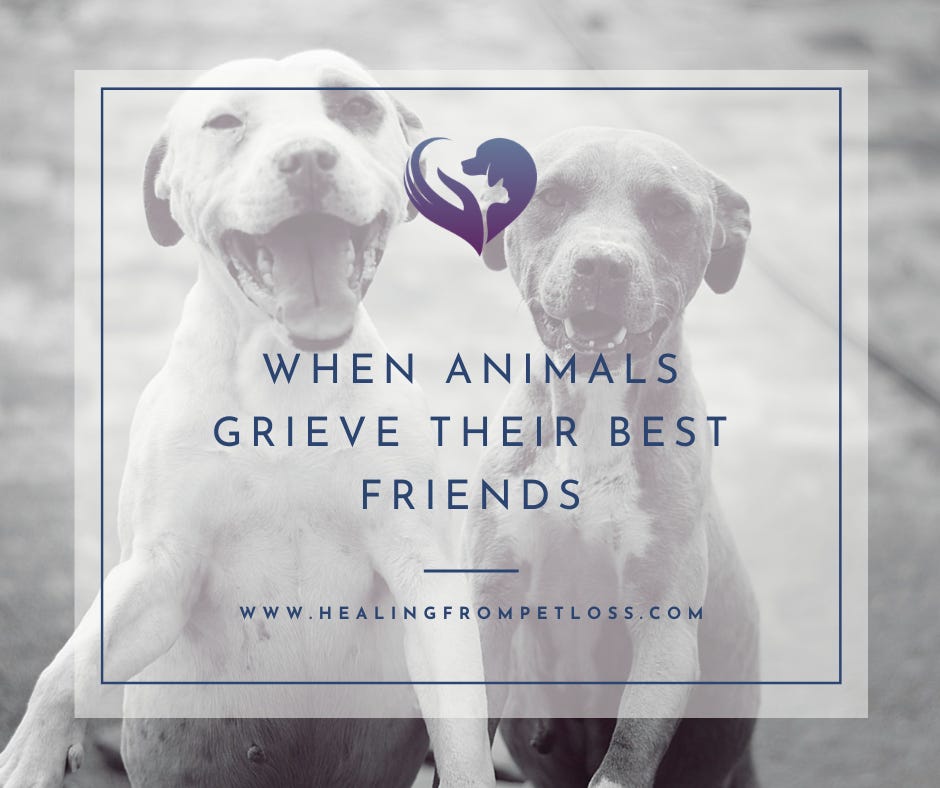
For six years, they were a pair.
Sydney was eight months old when we got Koda, a fat, wobbly puppy. That first week, she looked at him like a specimen, disdainfully observing his confusion over his new surroundings.
Sydney eventually decided he’d be worth experimental entertainment. I watched the first time she tried to play with him — cautious, a little terrified. But something clicked. I remember she jumped down from the couch he couldn’t yet reach. She stole the stuffy in his mouth, dashed around the coffee table, and then tossed it back to him as she sprinted back to the safety of the couch and surveyed the scene.
Koda was genuinely confused over what had happened. But his tail was wagging, so she tried it again, and then again, and soon they were playing like besties.
From then on, they were inseparable. Playing. Tearing things apart. Snuggling. Often, I’d have one on either side of me. That was our system.
Koda ate faster, but Sydney, though smaller, could hold her own — she wouldn’t be pushed around, and Koda knew it. As they got older, the wild play settled into quieter companionship. A steadiness. They just belonged near each other, the way some friendships get so easy you stop noticing any effort. It just is.
My kids like to say they were married. I called them siblings. Whatever it was, they were bonded. They had something, and it was theirs.
But all that disappeared when Koda died, suddenly and traumatically. Somewhere in the aftermath of losing him, I lost all awareness of the bond they’d had. I became consumed with my own grief. I wasn’t thinking about what losing him meant for Sydney.
And Then I Watched Her Look for Him
In retrospect I feel great pain at not being there for her in those early weeks of grief. It wasn’t until I looked at her one day, noticeably thinner, that it hit me how much she had been suffering.
I thought I had done the right thing by bringing her his ashes and his collar and letting her sniff them and explaining to her with loving pats on her head that he was gone. But that was the only effort I made for her, and I’m sure it took less than ten minutes.
Everything else was about me trying to survive that particularly painful period. Gradually, though, as I began to pay attention to her, I noticed that she would go to the places he used to lie and just stand there. She’d sniff his things and then go lie down. She started sleeping more than she ever had before. Sydney had always been a little more independent than Koda, happy to be in the same room but not on top of me.
That changed. She wouldn’t even follow me from room to room.
She was quieter. Not sick, not in pain — just quieter. Like something in the house was off and she was working out what.
It went on for weeks… dragged out into months. She seemed to be functioning normally. But she wasn’t herself, and I knew what I was seeing even though I hadn’t ever considered it.
The thing that broke me open — and somehow, also helped me — was realizing that she was mourning him too. That the loss in our house wasn’t only mine. That Koda had mattered to her in a way that left a mark when he was gone.

What the Research Has Started Saying
Scientists were skeptical for a long time that animals experience anything like grief. The concern was projection — that we were reading human emotion into animal behavior.
That has shifted. A study published in Scientific Reports surveyed people who had more than one dog when one of them died. Eighty-six percent reported behavioral changes in the surviving dog: less play, less appetite, more attention-seeking from the owner, increased fearfulness.
These changes lasted months on average.
Researchers who study animal behavior now broadly agree that social mammals — dogs, horses, elephants, primates — form genuine attachments, and that when those attachments end, something happens in them.
Whether we call it grief the way we mean it for humans is still debated.
But the idea that animals simply move on because they don’t understand what happened? That’s not supported by the evidence anymore.
Sydney understood something. I saw it. And it turns out I wasn’t projecting.
What It Gave Me That I Didn’t Expect
Watching Sydney grieve Koda gave me something I hadn’t anticipated: confirmation.
Not the kind I needed to believe my own grief was valid — I already knew that, even on the days it didn’t feel that way. But confirmation that their relationship, their bond, had been real. That Koda wasn’t only loved by me. That his presence had mattered beyond what I could see, in a whole separate relationship I hadn’t fully known I was living alongside.
That helped me. It made the loss feel the right size, in the way that real losses should — big, and overwhelming, and not something to be talked out of.
How to Help Your Own Pet Grieve
If you have another pet right now who is grieving alongside you, keep their routine as stable as you can. Structure helps when things feel wrong. Don’t push them to seem okay. If they want to be quieter, let them be quieter. If they want to be closer to you, be there. You’re both in it, and you’re both allowed to take as long as you take.
And if watching them grieve is adding to your own grief — I understand. It added to mine, and also, somehow, it helped.
I think that’s because it’s evidence you’re not alone in your broken heart. So if you’re in a similar situation, I invite you to make sure your other pets know they’re not alone, too.
This touched my heart and reminded me of two events. We always had dogs when I was growing up. We had a black and white cross collie/spaniel called Caesar who adored my dad and followed him everywhere. I was pregnant when my dad died and Caesar began to pine and often refused food. My daughter was born a fortnight after my dad died. I came home from hospital and sat on the sofa with her. Caesar jumped up beside me and began to sniff her and nudge her with his head. From that day Caesar never left my daughter’s side until he died 6 years later.
My mum had a black spaniel for eleven years. When my mum died, the dog came to live with me. I’d often looked after him when my mum was in hospital so he was used to spending time with me. After a few days he began to get anxious and began wandering around my flat as if looking for her.
For the next 3 weeks he followed me everywhere and howled if he was left alone.
He died in his sleep a month after my mum died. I think he missed his “mummy” too much