


There’s a belief tied to Día de los Muertos (Day of the Dead) that made me catch my breath the first time I heard it:
The animals come home first.
They come before the grandparents. Before the aunts and uncles and old friends. Before the children, the lovers, the parents.
Día de los Muertos, if you’re unfamiliar, is the vibrant Mexican holiday where families gather to welcome back, honor, and celebrate the souls of their deceased relatives.
In a version of the tradition that’s caught on across Mexico in recent years, October 27 belongs to the pets. It’s the night families set out water, kibble, a favorite toy, maybe a photo…
And then they wait for the dogs and cats they’ve lost to find their way back.
The people get November 1 and 2. The pets get their very own night, ahead of everyone else.
Koda was on my mind when I read that. My soul dog, gone suddenly and much too soon, 14 years ago now. The grief that followed was long and confusing. One of the hardest parts was that I didn’t know how to navigate pet grief. There was no church service to plan. No casseroles on the doorstep. No day on anyone’s calendar that marked the transition.
This tradition gives you that day.
And even though October 27 has already slipped past us, you haven’t missed your opportunity.
There’s no hard rule about when a pet’s ofrenda goes up or comes down. A lot of families leave it up straight through the main celebrations on November 1 and 2, and some simply fold their pets right into the family altar. Each household decides when to set it up and how long to keep it.
So today works. So does tonight.
Borrowing With Care
Before we get to the how-to, a quick but important word.
Día de los Muertos is a sacred holiday with deep Indigenous and Catholic roots. For many families, it’s a serious, heartfelt act of love for the ones who came before them.
Here in Albuquerque, the Muertos y Marigolds celebration in the South Valley is now in its 34th year, and its organizers ask everyone who comes to respect the holiday’s cultural, spiritual, ancestral, and religious meaning.
I think that’s a good rule for a home altar, too.
You don’t need to be Mexican or Catholic to build one for your pet. But I’d encourage you to build it with care… the way you’d hold someone else’s family heirloom. Tenderly.
And with a lot of gratitude for what it’s offering you.
The Dog Waiting at the River
This next part gets me a little teary, so consider yourself warned.
Long before October 27 became the pets’ night, dogs held a sacred place in Mexica (Aztec) beliefs about death. The soul’s trip to Mictlán, the land of the dead, was said to take four years. And somewhere along the way, it reached a wide river.
According to Bernardino de Sahagún, the Spanish friar who recorded these beliefs in the 1500s, dogs waited on the shore. When a dog recognized its master, it threw itself into the water and carried that person across.
When it recognized its master.
The animal knew you. Instantly. And it came for you.
Today the hairless Xoloitzcuintli is the breed most tied to this role, though archaeologists have found many kinds of dogs in ancient burial sites. But the breed matters a lot less than the belief behind it… that the bond between a person and their animal was strong enough to cross over death itself.
The Grief Science Angle
Modern grief researchers have a name for this, too. They call it a “continuing bond,” which is the idea that our relationship with someone we’ve lost carries on, just in a new form.
In one study of bereaved pet owners, keeping that connection alive through memories, belongings, and memorials turned out to be more comforting than distressing for most people. (Many people fear that confronting their grief will make it feel worse… but that’s just not the case.)
The ofrendas that are built during Día de los Muertos are a powerful way to keep that connection alive, because an ofrenda is a continuing bond you can actually touch.
What Goes on the Altar
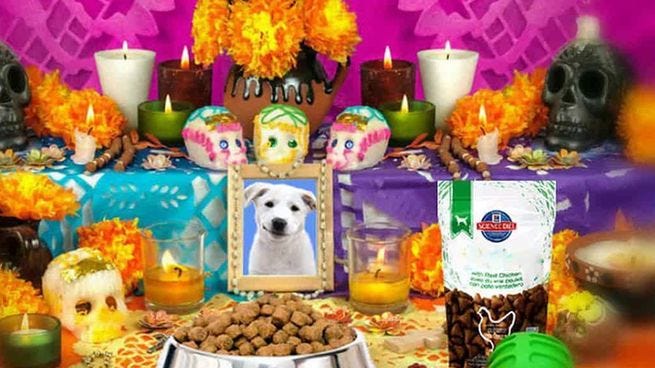
You don’t need anything fancy. A photo, a bowl of water, a few flowers, and a toy can be plenty.
Here’s what each traditional piece means, and how to make it particular to you and your pet:
A photo. This sits at the center. Skip the posed portrait and go for the one that looks most like them… ear flipped inside out, tongue hanging, mid-zoomie.
Water. Souls are said to arrive thirsty after their long trip, so fresh water is a must. Use your pet’s actual bowl if you still have it.
Their favorite food. Kibble. A treat. The cheese they begged for every single time you opened the fridge.
Marigolds (cempasúchil). Their bright color and strong scent are believed to guide souls home, and some families scatter petals in a path from the front door to the altar.
A candle. The light shows them the way home. LED candles work just fine, especially if a living pet with a curious nose or a busy tail shares your home.
Their things. Their collar. Their tag. The blanket that still smells like them. And if you kept their ashes, those can go on the altar, too.
Papel picado (those colorful cut-paper banners) and copal incense are traditional extras if you’d like to add them.
The Weird Little Details
Here’s something no checklist includes: the altar works best when it’s oddly, wonderfully specific. Maybe for you that means
The squeaky hedgehog that lost its squeak years ago.
The sock they stole every morning and paraded around the living room.
The brand of tuna that brought the cat running from three rooms away.
On my ofrenda for Koda, it’s the silly frisbee he’d flip over to balance tiny balls on.
Specific objects pull up specific memories. And those memories are where your pet lives on in your heart.
As you set each item down, say out loud why it’s there. Something like, “This is your ball. You dropped it on my foot every night while I was trying to make dinner.”
It might feel awkward for about thirty seconds. And then it won’t.
When to Take It Down
On November 2, or whenever it feels right to you, take the altar down. Do it slowly. If you set out unopened treats or food, consider donating them to a local shelter in your pet’s name.
Then tuck the photo and the collar somewhere you can find them next fall.
Because that’s the beautiful gift of this tradition… it comes back around. On every Día de los Muertos, your pet gets their night of remembrance all again. And you get a place to put all that love, alongside a whole community doing the very same thing.
Your Invitation
I invite you to build a small ofrenda for your pet before November 2. One photo, one bowl of water, and one favorite treat is enough.
Then, if you’d like, come back and tell me about it in the comments. What did you put on the altar, and why? Share their name, too. I’d love to say it with you. 💗🐾
Thank you. "The animals come home first" - I did not know this. I find it brave and honest that people build little altars to animals, and human family members alike. A dog is unconditional love. They deserve it.
PS. I lost my dog in September. Here is my story:
https://nomadicmind.substack.com/p/fifteen-years-between-two-cries
I don't know much about ofrenda but I do have a small mini corner full of my dogs stuff and it solely belongs just to him even though I don't celebrate this festival yet on each birthday it's like an ofrenda between me and my late dog but thankyou.