

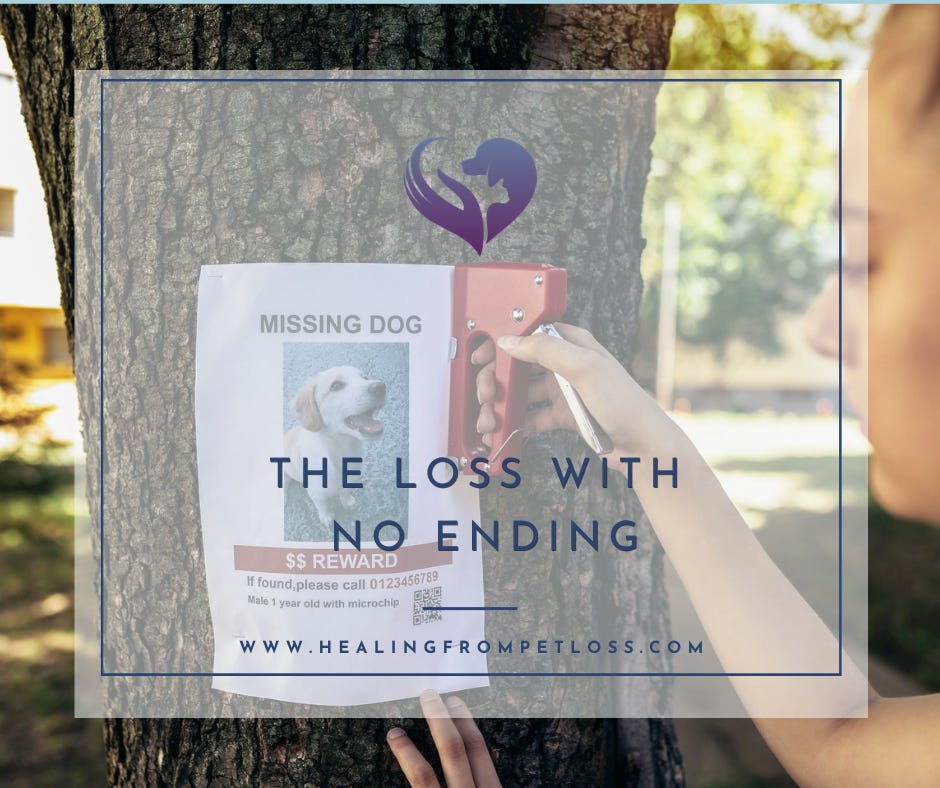
My long-time childhood kitty, Sammy, went missing when I was a teenager. But I never once doubted we’d find him. A stealthy, highly independent cat, he was obviously out exploring.
My mom found him a few days later through the website of a local animal shelter where someone had dropped him off. The picture didn’t look like my sweet cat at all—just an irate black ball of fur.
Looking back, I can’t imagine what my mom went through, having raised Sammy up from his kitten days till 17 or 18 years by that time. I was too wrapped up in my own teenage drama to really worry.
But she’d had him longer than she had any of her kids and I imagine it was terrifying.
That’s the thing about losing a pet that goes missing…
It’s different from most pet losses. However devastating, those other losses come with black-and-white finality. There’s a last moment you can point to. A date that becomes the dividing line between before and after.
But when a pet just disappears, you don’t get any of that.
The collar still hangs on its hook.
The food bowl is there, waiting to be filled.
You can’t stop opening the door to check one last time, going for late-night walks with a flashlight, or combing “lost pet” posts.
Because somewhere, deep down, part of you insists today might be the day they come back.
It doesn’t even matter whether it’s weeks or months later. Hope can stay alive with very little fuel.
And as humans, we’re drawn to hope and story. Just look at all the movies that encourage this line of thinking: Homeward Bound. The Incredible Journey. A Dog’s Way Home.
Because sometimes, just like my Sammy kitty, pets do return home. So it feels wrong and unnatural and kind of like losing faith in your pet to give up on their return.
Life In Limbo
The truth is, a pet that disappears is one of the most painful yet least acknowledged forms of pet loss. Yet it’s not because the grief is any different than other types of losses. It’s because in addition to the grief of loss, there’s no resolution to bookend the grief.
It’s difficult to process what happened when you may still have a future with your pet.
It also leaves you sort of at a loss as to what to do. Memorials, rituals, funerals, and tributes go a long way in helping us work through grief. But it feels wrong to do any of this if you might still see your pet again, or if their state of being gone will ever change.
And so you’re left in agonizing limbo with no clear distinction as to when it is okay to begin processing what happened and move on.
The Grief Science Angle
Grief researchers have a name for this type of loss, thanks to family therapist and researcher Pauline Boss. She coined the term “ambiguous loss” to describe losses with no clear ending.
The situations behind ambiguous loss tend to be those where someone is physically absent but psychologically present, where the loss itself remains unconfirmed, and the possibility of that someone coming back is always present.
A missing pet is a textbook case of ambiguous loss: The absence is real, but the loss is not confirmed.
It’s a state of being where your mind tumbles and worries and exhaustively toggles back and forth between worry, hope, grief, and questioning.
One moment you’re grieving.
The next moment you’re angry at yourself for losing hope.
Then you’re questioning every last moment and searching for clues.
And for fleeting moments, you become sure you can solve the mystery and bring the pet home.
Boss’s research found that ambiguous loss is among the most difficult forms of grief to integrate into your life precisely because the uncertainty keeps the wound fresh. She also identified what she called “boundary ambiguity,” which is the difficulty of not knowing how to classify someone’s place in your life when it’s unclear where they’ve gone.
Do you speak about your pet in present or past tense?
Do you keep their things or put them away?
Do you create a memorial?
Put together a tribute?
Let everyone in your life know?
Also, in a case of ambiguous loss, your brain enters a high state of alert, constantly flooded with stress hormones. It’s hard for the mind to maintain that kind of crisis level indefinitely, and so every small daily decision becomes its own source of micro-grief.
It’s as if you’re constantly renegotiating reality.
And the way this saps your energy is extensive. The cognitive and emotional load is exhausting in ways that are genuinely hard to describe to someone who has never been through it.
Especially when, in a lot of cases, your own brain forces you to detach and give up hope just to protect you from the crushing weight of continuous grief and anxiety.
If this is you right now, know that it’s an act of survival and not a lack of love or loyalty.
What Not to Say, Ever
There’s another side to pet loss where pets go missing, which consists of all the unintentionally painful things well-meaning people might say. Things like
“I’m sure they’ll come back.”
“Why don’t you get another one until they show up?”
“They probably found a good home.”
“Have you tried looking? Have you done X, Y, Z?”
Or the worst of all: “At least you don’t know for sure.”
Granted, these comments are offered as comfort, but they kind of come across as instructions not to grieve. This leaves you stuck in a loop where you stay hopeful and cheerful and don’t give your sadness its day in the sun.
But the truth is, for most people, the uncertainty of not knowing is much more painful than a confirmed death because it keeps the hope going long past when hoping is maybe unsustainable.
3 Simple Steps For Wading Through
While there’s never any specific prescription that works for everybody, here’s what might help you navigate this difficult road:
First, yes, this is still a true loss. Your pet is somewhere else with someone else and you don’t actually know if they’re okay. It’s uncomfortable and you don’t have answers. There’s no clarity. There’s no final moment where you pick up and move on.
So allow yourself to treat it like a true loss:
This means you acknowledge that the grief is there. You honor that grief by crying, stomping, journaling, screaming—whatever it is you need to wade through it, and as many times as you need to do it.
Acknowledge the additional pain of not having closure. Maybe that means more tears. Maybe it just means telling yourself it’s okay to feel pain from not knowing.
Understand that you don’t need a confirmed ending to deserve support. You’re worthy of support when you’re in pain, no matter what that pain looks like.
It also helps a lot, however small it sounds, to have people in your life who can hold both possibilities alive with you instead of diverting to false reassurances.
Here’s what that person might say and what I encourage you to say if you’re ever helping someone through this kind of ambiguous loss: “I know you don’t know yet, and I’m here with you in the not knowing.”
That’s worth more than a hundred people offering premature comfort.
If you don’t have someone in your life right now, finding a community like this one that understands ambiguous loss can be the very thing that keeps you from going under.
Small Solaces
The takeaway here is that closure isn’t a prerequisite for grieving, nor for healing. Grief science has made this abundantly clear.
And as an eternal optimist myself, you don’t have to hold out constant second-by-second hope for your pet’s return. You absolutely can still hope, but in between, you can let yourself grieve because it’s really, really hard, painful, and devastating to lose a pet in any way for any amount of time.
At some point, many people find that it’s helpful to create a simple form of acknowledgment that the pet is still in their heart and that they’re still holding out hope, but that they are also sitting in some type of remembrance.
It’s kind of like channeling your grief and giving it a dedicated place to go.
A small memorial by your bedside with a picture of your pet and a candle might be all you need. Putting together such a memorial doesn’t mean you’re giving up or that you believe this is how this story ends.
You might also write a letter or begin a morning ritual that says, “I loved you. I still love you. I looked. I’m going to keep looking.”
Regardless of what happened to your pet, you can hold on to the one firm truth that stands:
They were loved and you were loved in return, absolutely and completely and without any asterisks.
This will always hold true, no matter how the story finally ends.
This is SO important to understand! Thank you Mindy for sharing this with your Substack family.